
GLOBAL SELLING BLOG
Spices export from India: A guide on how to export spices from India
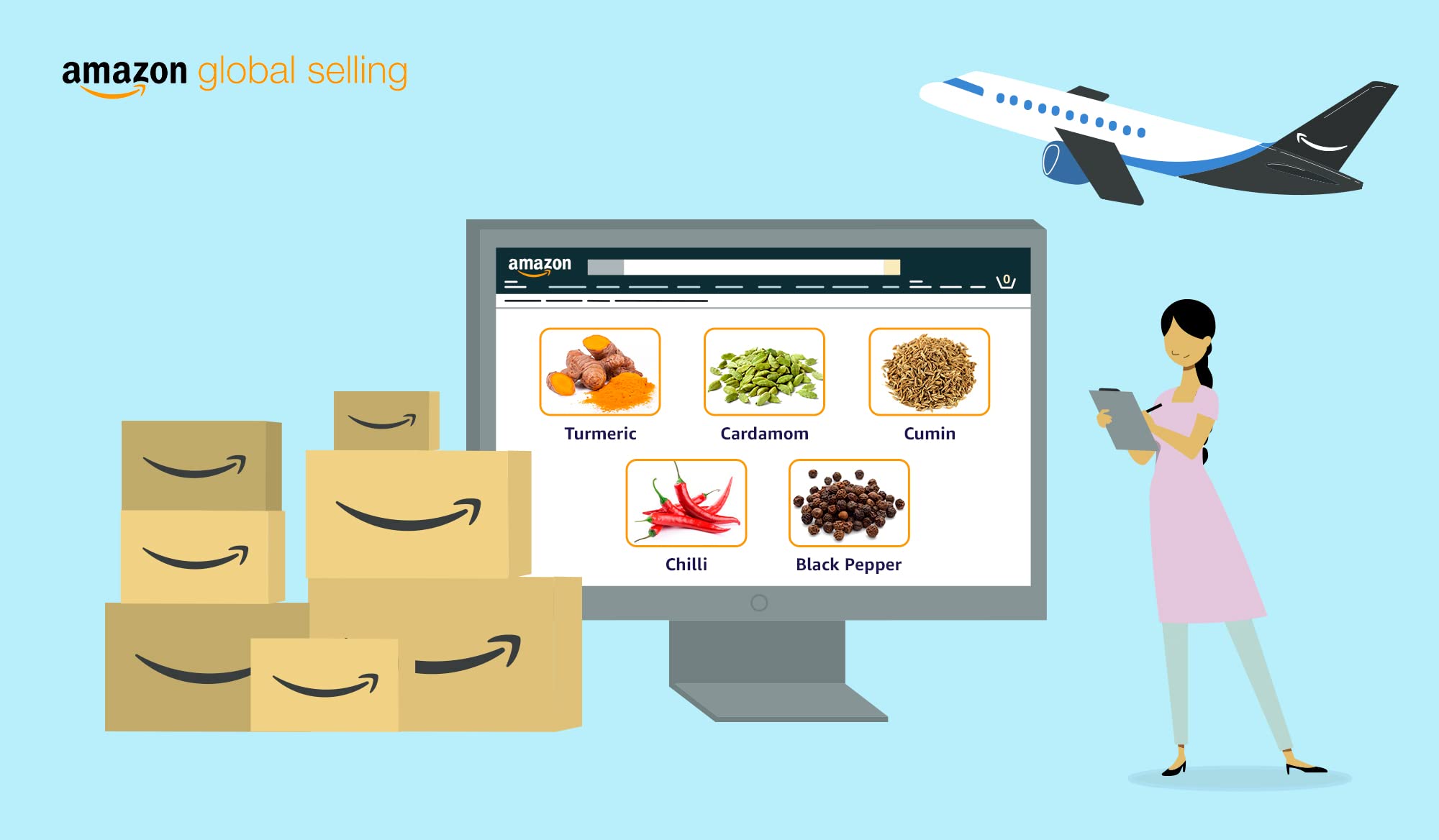
From cardamom, turmeric to cilantro and cumin, sellers can start spices export business from India in an easy and hassle-free way with Amazon Global selling. We tell you everything you need to know to run your export business in this blog.

Meet Manish Jain – a Rajasthan-based seller, who chose the road not taken by his family and started a spice export business from India. “So many herbs, so many spices – that’s what I love about India,” the founder of Herbs & Crops Overseas proudly says. While his family had an electronic business, Manish knew he wanted to take Indian taste to the world with his brand. Through ecommerce exports, he could achieve this in a seamless manner. “Starting from a 200 sq. ft office space to a 200% profitable spices export business in the UK and Japan, Amazon Global Selling has helped me achieve my dreams,” he adds.
Manish’s success story highlights the export potential of Indian spices, which are highly sought-after globally for their natural health benefits and essential role in Ayurvedic medicine. In this blog post, we will explore some key facets of the spices export sector in India, providing sellers with an in-depth guide to establishing and expanding their spices export ventures.
Manish’s success story highlights the export potential of Indian spices, which are highly sought-after globally for their natural health benefits and essential role in Ayurvedic medicine. In this blog post, we will explore some key facets of the spices export sector in India, providing sellers with an in-depth guide to establishing and expanding their spices export ventures.
Key trends in India’s spice export sector
India is the world’s largest producer and exporter of spices and spice items, producing approximately 75 of the 109 varieties of spices listed by the International Organization for Standardization (ISO).1
Some key exports trends are as follows:
● In 2022-23, the export of spices from India stood at $3.73 billion.
● Chili, cumin, turmeric, ginger and coriander account for about 76% of total production.
● The top spices-producing states in India are Madhya Pradesh, Rajasthan, Gujarat, Andhra Pradesh, Telangana, Karnataka, Maharashtra, Assam, Orissa, Uttar Pradesh, West Bengal, Tamil Nadu, and Kerala.2
Some key exports trends are as follows:
● In 2022-23, the export of spices from India stood at $3.73 billion.
● Chili, cumin, turmeric, ginger and coriander account for about 76% of total production.
● The top spices-producing states in India are Madhya Pradesh, Rajasthan, Gujarat, Andhra Pradesh, Telangana, Karnataka, Maharashtra, Assam, Orissa, Uttar Pradesh, West Bengal, Tamil Nadu, and Kerala.2
What spices can be exported from India?
Different spices are used in different ways in our daily lives. Some are used as appetizers, some as preservatives, and some are used in Ayurveda or herbal beauty and skincare products. The top spices exported from India include:
● Pepper
● Cardamom
● Chilli
● Ginger
● Turmeric
● Coriander
● Cumin
● Celery
● Fennel
● Fenugreek
● Garlic
● Nutmeg
● Mace
● Curry powder
● Spice oils
● Oleoresins3
● Pepper
● Cardamom
● Chilli
● Ginger
● Turmeric
● Coriander
● Cumin
● Celery
● Fennel
● Fenugreek
● Garlic
● Nutmeg
● Mace
● Curry powder
● Spice oils
● Oleoresins3

What are the top countries for spices export from India?
The leading destinations for spices exports from India in FY 2023 were:
● The USA
● Bangladesh
● The UAE
● Sri Lanka
● The UK
● Saudi Arabia
● Germany
● Singapore
● Japan
● Spain4
● The USA
● Bangladesh
● The UAE
● Sri Lanka
● The UK
● Saudi Arabia
● Germany
● Singapore
● Japan
● Spain4
Spices Board of India: Promoting spices export from India
The Spices Board of India is a statutory body established under the Spices Board Act, 1986. It was formed by merging the erstwhile Cardamom Board and the Spices Export Promotion Council, operating under the purview of the Department of Commerce. Its core responsibilities include:
● The development, promotion, and export regulation of the 52 spices listed in the schedule of the Spices Board Act, 1986.
● The overall development of the cardamom industry, including domestic marketing and export of small and large cardamom.5
● The development, promotion, and export regulation of the 52 spices listed in the schedule of the Spices Board Act, 1986.
● The overall development of the cardamom industry, including domestic marketing and export of small and large cardamom.5
Government initiatives for spices export
The government of India has launched several schemes and initiatives to promote the export of spices from the country. Some key initiatives are listed below:
1. Export Development and Promotion of Spices Scheme
This initiative by the Spices Board of India aims to help exporters adopt high-tech processing technologies and upgrade existing technology to develop capabilities to meet the changing food safety standards worldwide. The initiative offers support for infrastructure development, promotion of Indian spice brands in foreign markets, infrastructure setup in major spice growing centres, and promotion of organic spices.
2. Setting up and maintenance of infrastructure for common processing (Spices Parks)
The Spices Board of India has launched eight crop-specific Spices Parks in major market centres. The aim is to facilitate improved price realization for farmers and connect them with a wider range of buyers. These parks also aim to integrate operations for cultivation, post-harvesting, value-addition, packaging, and storage of spices and spice products.6
Documents required for spices export
Indian exporters who wish to start a spice export business from India need to have the following documents:
● Company PAN card
● Importer exporter code
● Incorporation certificate
● MSME registration certificate
● RCMC from Spices Board
● Trademark registration
● FSSAI registration/license
● Passport-size photograph of the exporter
● Phytosanitary certificate
● Bank statement
● Authorized dealer code from a recognized bank
● GST documentation7
● Company PAN card
● Importer exporter code
● Incorporation certificate
● MSME registration certificate
● RCMC from Spices Board
● Trademark registration
● FSSAI registration/license
● Passport-size photograph of the exporter
● Phytosanitary certificate
● Bank statement
● Authorized dealer code from a recognized bank
● GST documentation7
How to export spices from India with Amazon Global Selling?
With increasing global demand, the spices export sector in India holds countless opportunities for Indian exporters. In recent years, many sellers are increasingly opting for e-commerce exports – an easy and seamless way to sell internationally online. Amazon Global Selling is an e-commerce exports program that helps exporters sell on 18 Amazon international marketplaces like the US, the UK, Italy, the UAE, Saudi Arabia, Australia, Japan and more. From simple registration to attractive listing and hassle-free shipping, Amazon Global Selling offers several tools and solutions to enable sellers to reach millions of customers.
Register your business
Register your export business on Seller Central by submitting some KYC documents and debit/credit card details.
List your products
Once registered, you can list your products. Remember to follow tips on how to list your products and include attractive pictures and descriptions that’s clear to international customers. You can also seek help from third party service providers..
Ship and receive payments
Once a customer places an order, you can choose to deliver by yourself or you can opt for Fulfillment by Amazon (FBA). Under FBA, Amazon takes care of shipping, delivery, returns and customer concerns. Once a customer purchases your product, Amazon credits the money in your bank account in the currency of your choice.


Frequently Asked Questions
Which countries import spices from India the most?
Indian spices were exported to 180 countries as of 2022.8 Top destinations include the US, Bangladesh, the UAE, Sri Lanka, and the UK, among others.
Which states in India are the major producers of spices?
The top spice-producing states in India are Madhya Pradesh, Rajasthan, Gujarat, Karnataka, Telangana, Andhra Pradesh, Maharashtra, Orissa, Assam, Uttar Pradesh, West Bengal, Tamil Nadu, and Kerala (as of FY 23).9
How can I start my spices export business from India?
You can start your spices export business from India with Amazon Global Selling and reach customers in 200+ countries and territories around the world. You can get started with just 3 simple steps:
1. Register your business.
2. List your products.
3. Ship and receive payments (you can deliver your products yourself or opt for Fulfillment by Amazon (FBA) for hassle-free shipping).
1. Register your business.
2. List your products.
3. Ship and receive payments (you can deliver your products yourself or opt for Fulfillment by Amazon (FBA) for hassle-free shipping).
Published on September 22, 2021.
Sources:
1. https://www.ibef.org/exports/spice-industry-india
2. https://www.ibef.org/exports/spice-industry-india
3. https://www.indiantradeportal.in/vs.jsp?lang=0&id=0,31,24100,24119
4. https://www.statista.com/statistics/624780/export-value-of-spice-by-country-india.
5. https://www.indianspices.com/
6. https://www.ibef.org/exports/spice-industry-india
7. https://vakilsearch.com/blog/how-to-start-a-spice-export-business-in-india/
8. https://www.ibef.org/exports/spice-industry-india
9. https://www.statista.com/statistics/870934/spice-production-by-state-india/
Sources:
1. https://www.ibef.org/exports/spice-industry-india
2. https://www.ibef.org/exports/spice-industry-india
3. https://www.indiantradeportal.in/vs.jsp?lang=0&id=0,31,24100,24119
4. https://www.statista.com/statistics/624780/export-value-of-spice-by-country-india.
5. https://www.indianspices.com/
6. https://www.ibef.org/exports/spice-industry-india
7. https://vakilsearch.com/blog/how-to-start-a-spice-export-business-in-india/
8. https://www.ibef.org/exports/spice-industry-india
9. https://www.statista.com/statistics/870934/spice-production-by-state-india/
Sell across the world with Amazon Global Selling
Ready to start exporting from India?
Want to learn about Amazon Global Selling?
Disclaimer: Whilst Amazon Seller Services Private Limited ("Amazon") has used reasonable endeavours in compiling the information provided, Amazon provides no assurance as to its accuracy, completeness or usefulness or that such information is error-free. In certain cases, the blog is provided by a third-party seller and is made available on an "as-is" basis. Amazon hereby disclaims any and all liability and assumes no responsibility whatsoever for consequences resulting from use of such information. Information provided may be changed or updated at any time, without any prior notice. You agree to use the information, at your own risk and expressly waive any and all claims, rights of action and/or remedies (under law or otherwise) that you may have against Amazon arising out of or in connection with the use of such information. Any copying, redistribution or republication of the information, or any portion thereof, without prior written consent of Amazon is strictly prohibited.
*Map not to scale. The map has been used for design and representational purpose only, it does not depict the geographical boundaries of the country. These do not conform to the external boundaries of India recognized by the Survey of India.
*Map not to scale. The map has been used for design and representational purpose only, it does not depict the geographical boundaries of the country. These do not conform to the external boundaries of India recognized by the Survey of India.

Get started with $50,000 in potential incentives.


© 2024 Amazon.com, Inc. or its affiliates. All rights reserved
