
GLOBAL SELLING BLOG
What is a shipping bill in export: Meaning, types and how to apply on ICEGATE
While shipping export products from India, it’s important to understand and obtain a shipping bill depending on your product category and destination country. Here’s a guide for Indian exporters to learn about shipping bill in export.

In export trade, international shipping and delivery is an important step – making sure products reach the importer or end-customer without any damage is key to a successful export business. In this process, a shipping bill is an essential document issued by the Customs Service Centre1. This bill allows an exporter to get customs clearance and initiate shipping.
While sending products from one country to another, an exporter has to go through various formalities like submitting a few applications, acquiring licenses, paying duties, etc. To obtain clearance from customs, an exporter has to apply for a shipping bill to avoid any challenges while shipping. All products can only be exported out of the country if the shipping bill has been checked by the customs with ‘Let Export Order’ and ‘Let Ship Order’.
While sending products from one country to another, an exporter has to go through various formalities like submitting a few applications, acquiring licenses, paying duties, etc. To obtain clearance from customs, an exporter has to apply for a shipping bill to avoid any challenges while shipping. All products can only be exported out of the country if the shipping bill has been checked by the customs with ‘Let Export Order’ and ‘Let Ship Order’.
What is a shipping bill and what is its utility?
A shipping bill is an important document that an exporter needs to obtain from the customs department before getting his products ready to ship from India. While shipping products from one country to another, an exporter is required to follow a certain export procedure, obtain documents and get clearance from customs. After receiving a shipping bill, the customs authority conducts inspection, post which, it issues an Let Export Order – the final legal procedure required to move goods out of India. This process is completed by the Indian Customs Department by finding out the net value of the goods to be exported) on the shipping bill which is signed and sealed by customs officers2.
What does the shipping bill include?
A shipping bill usually includes:
• Details of exporter, buyer or importer and customs agent
• Name of the vessel
• Transportation and port of loading and discharge details
• Cargo details (gross and net weight, nature)
• Invoice details (number of commercial invoices, nature of payment, invoice value in both currencies)
• GST and export duty-related information
• FOB (Freight on Board) price and insurance amount of items
• Container numbers
• Duty Drawback details
• Nature of goods exported
• Country of destination and the port at which goods are to be discharged
• Exporter’s address
• Importer’s address
• Details of packages such as numbers and marks
• Name of the vessel
• Transportation and port of loading and discharge details
• Cargo details (gross and net weight, nature)
• Invoice details (number of commercial invoices, nature of payment, invoice value in both currencies)
• GST and export duty-related information
• FOB (Freight on Board) price and insurance amount of items
• Container numbers
• Duty Drawback details
• Nature of goods exported
• Country of destination and the port at which goods are to be discharged
• Exporter’s address
• Importer’s address
• Details of packages such as numbers and marks
Types of shipping bills in export
Dutiable shipping bill
Payment of export duty on goods to be exported and here ‘dutiable shipping bill’ is to be filed.
Drawback shipping bill
Drawback shipping bill is to be filed for goods which are for refund purposes.
Ex-bond shipping bill
Goods that are imported and stored in the bonded warehouse which are to be re-exported have to be filed under ex-bond shipping bill.
Coastal shipping bill
When goods are required to be shipped and they are needed to be moved from one port to another port, coastal shipping bill needs to be filed.
How to get a shipping bill from ICEGATE?
To obtain a shipping bill from ICEGATE, an exporter can follow the below-mentioned steps3:
• An exporter has to register with the customs department on their website (ICEGATE) with IEC or Customs House Agents license number and AD Code of the respective bank.
• Post that, exporter can sign in to ICEGATE and fill the required details in the prescribed format, along with necessary documents, and submit it.
• Once the application has been verified, ‘Let Export Order’ will be issued by the officer.
• After this is issued, the shipping bill is generated.
• An exporter has to register with the customs department on their website (ICEGATE) with IEC or Customs House Agents license number and AD Code of the respective bank.
• Post that, exporter can sign in to ICEGATE and fill the required details in the prescribed format, along with necessary documents, and submit it.
• Once the application has been verified, ‘Let Export Order’ will be issued by the officer.
• After this is issued, the shipping bill is generated.
Following are the steps to check the status of a shipping bill:
1. Login to ICEGATE using your login credentials.
2. Click on ‘Job Status’ link on the left menu of available services.
3. On the ‘Job Status’ page, click on ‘Shipping Bill (24 Hrs)’ and select the appropriate location from the drop down.
4. Submit the required details.
1. Login to ICEGATE using your login credentials.
2. Click on ‘Job Status’ link on the left menu of available services.
3. On the ‘Job Status’ page, click on ‘Shipping Bill (24 Hrs)’ and select the appropriate location from the drop down.
4. Submit the required details.
You can view details of all shipping bills filed from the selected location in the last 24 hours. These details include job number, job date, Customs location name, along with details of the various stages of the shipping bills.
To make your export journey from India easy and simple, Amazon Global Selling enables you to sell internationally via e-commerce, while supporting you with compliance and shipping solutions for hassle-free exports.
To make your export journey from India easy and simple, Amazon Global Selling enables you to sell internationally via e-commerce, while supporting you with compliance and shipping solutions for hassle-free exports.
Easy e-commerce exports with Amazon
Global Selling
As an e-commerce exports program, Amazon Global Selling enables Indian sellers and MSMEs to take their products from India to international marketplaces across 200+ countries and territories. Without having to set up a physical store or warehouse abroad, Amazon’s simple registration process and hassle-free logistic support helps you reach global customers in a seamless manner.
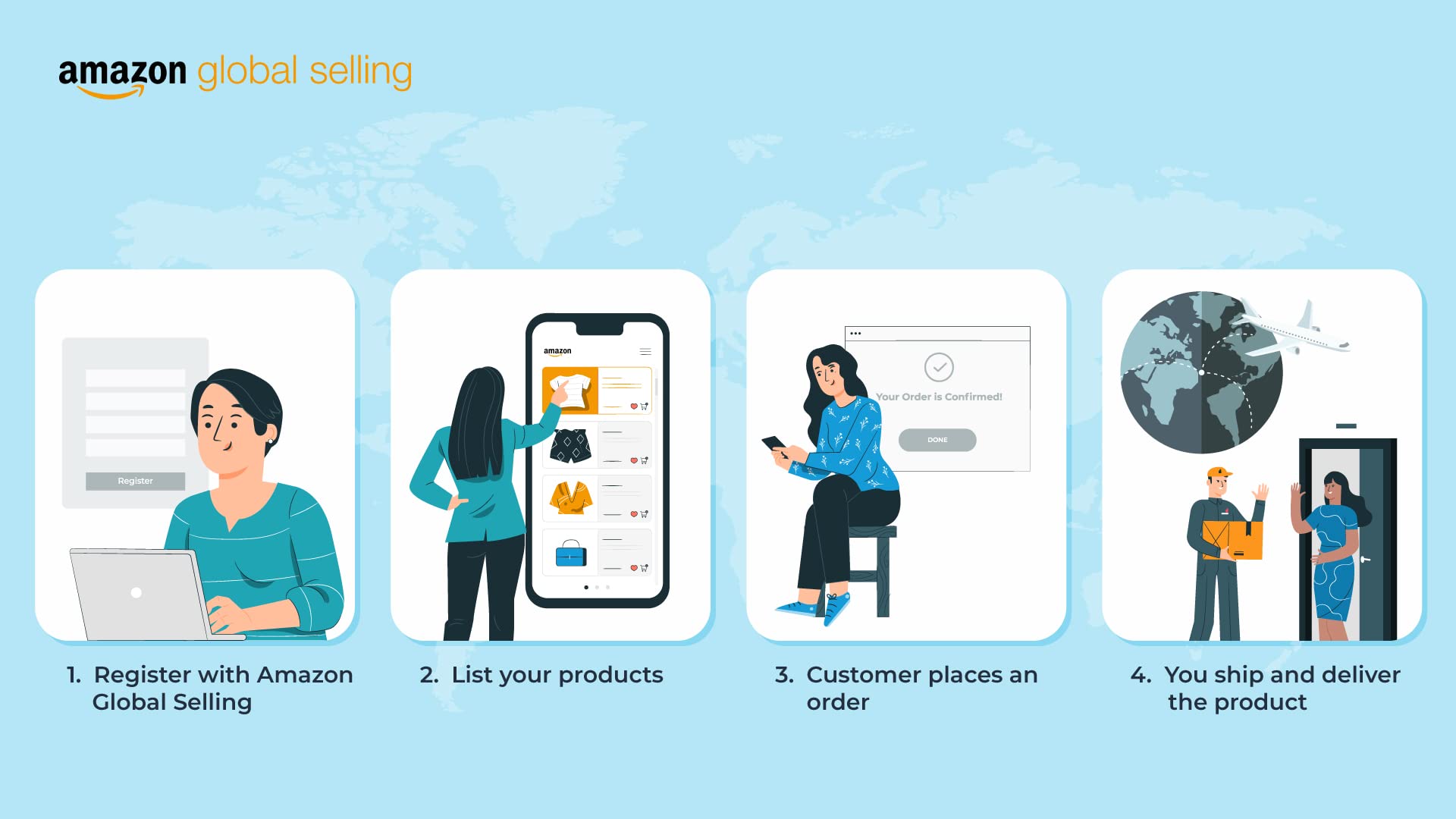
Fulfillment by Amazon (FBA) provides assistance for Indian exporters to store, pack, ship and deliver their products across the globe. When you choose FBA to dropship your products, here’s what you get:
- Amazon stores your products in the Amazon Fulfilment center.
- Amazon handles quick delivery to destinations across the globe with the Prime shipping option.
- Amazon offers 24/7 customer service
- Amazon FBA takes care of the returns
- Amazon FBA notifies you when you need to restock the products (if needed).
To support you for hassle-free logistics, Amazon has also launched SEND, enabling you to ship directly to international fulfillment centers at competitive prices. All you have to do is book, pay and track shipments without any hassles from India to the world.
- Amazon stores your products in the Amazon Fulfilment center.
- Amazon handles quick delivery to destinations across the globe with the Prime shipping option.
- Amazon offers 24/7 customer service
- Amazon FBA takes care of the returns
- Amazon FBA notifies you when you need to restock the products (if needed).
To support you for hassle-free logistics, Amazon has also launched SEND, enabling you to ship directly to international fulfillment centers at competitive prices. All you have to do is book, pay and track shipments without any hassles from India to the world.
Frequently Asked Questions
How can I get an export shipping bill?
You can apply for a shipping bill by registering on ICEGATE and submitting required documents, along with the application.
Who prepares the shipping bill?
This is prepared by the Customs Service Centre after an exporter applies for it.
What is the difference between the bill of lading and a shipping bill?
A shipping bill is a bill for shipment needed for custom clearance while you are exporting products. Bill of lading is issued by the shipping company to the transporter when the transporter loads goods to the ship.
Published on July 12, 2022.
Sources:
1. https://www.cbic.gov.in/htdocs-cbec/customs/cs-act/formatted-htmls/cs-import-regu2
2. https://www.indiafilings.com/learn/shipping-bill/
3. https://www.icegate.gov.in/Download/FAQs_Final_Draft_Uploaded.pdf
4. https://enquiry.icegate.gov.in/enquiryatices/sbTrack
5. http://dgftebrc.nic.in:8090/SBQry/SBIec_index.jsp
Sources:
1. https://www.cbic.gov.in/htdocs-cbec/customs/cs-act/formatted-htmls/cs-import-regu2
2. https://www.indiafilings.com/learn/shipping-bill/
3. https://www.icegate.gov.in/Download/FAQs_Final_Draft_Uploaded.pdf
4. https://enquiry.icegate.gov.in/enquiryatices/sbTrack
5. http://dgftebrc.nic.in:8090/SBQry/SBIec_index.jsp
Disclaimer: Whilst Amazon Seller Services Private Limited ("Amazon") has used reasonable endeavours in compiling the information provided, Amazon provides no assurance as to its accuracy, completeness or usefulness or that such information is error-free. In certain cases, the blog is provided by a third-party seller and is made available on an "as-is" basis. Amazon hereby disclaims any and all liability and assumes no responsibility whatsoever for consequences resulting from use of such information. Information provided may be changed or updated at any time, without any prior notice. You agree to use the information, at your own risk and expressly waive any and all claims, rights of action and/or remedies (under law or otherwise) that you may have against Amazon arising out of or in connection with the use of such information. Any copying, redistribution or republication of the information, or any portion thereof, without prior written consent of Amazon is strictly prohibited.
*Map not to scale. The map has been used for design and representational purpose only, it does not depict the geographical boundaries of the country. These do not conform to the external boundaries of India recognized by the Survey of India.
*Map not to scale. The map has been used for design and representational purpose only, it does not depict the geographical boundaries of the country. These do not conform to the external boundaries of India recognized by the Survey of India.
Related blogs
Success stories


Get started with $50,000 in potential incentives.


© 2024 Amazon.com, Inc. or its affiliates. All rights reserved
